Key Takeaways
- Most opener problems are small: dead remote batteries, misaligned safety sensors, a tripped outlet, or worn gears. Those are repairs.
- Fixr puts opener repairs at about $100–$300 and sensor replacement at $100–$150.
- A new opener installed averages about $480, with a typical range of $300–$600.
- Openers usually last 10 to 15 years. Past that, replacing often beats repeated repairs.
- Federal rules require openers to reverse within 2 seconds of hitting an obstruction. If yours fails the reverse test, fix it or replace it now.
Repair your garage door opener if it is under about ten years old, passes the safety reverse test, and the problem is a single part. Replace it if it is older, fails the reverse test after adjustment, or has needed more than one repair in a year. Here is how to tell which side of that line you are on.
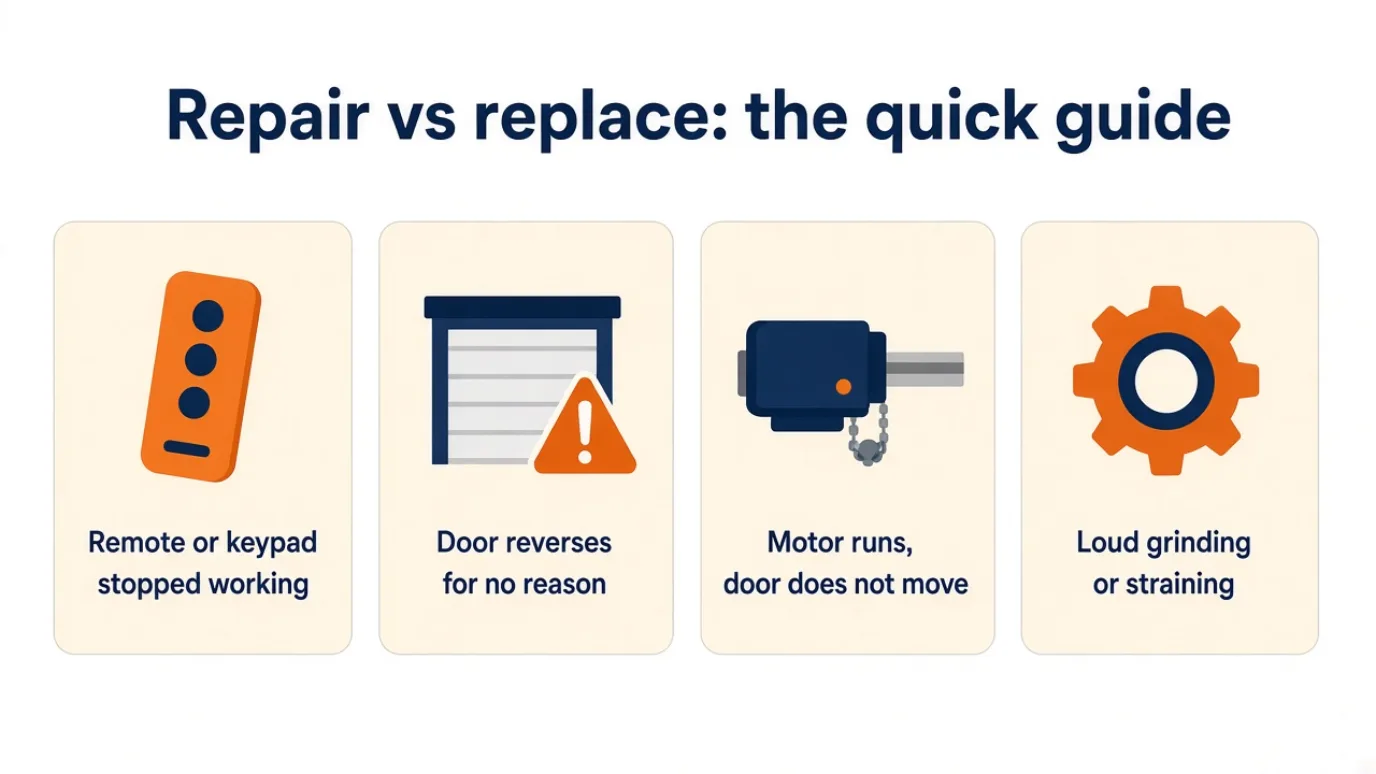
Repair vs replace: the quick guide
| Situation | Repair | Replace |
|---|---|---|
| Remote or keypad stopped working | Yes, batteries or reprogramming | Only if very old |
| Door reverses for no reason | Yes, align or clean sensors | If sensors keep failing |
| Motor runs, door does not move | Yes, often a gear or trolley | If the unit is past 12 to 15 years |
| Loud grinding or straining | Check the door first | If the motor is failing |
| Fails the safety reverse test | Adjust force settings | If adjustment does not fix it |
| No photo-eye sensors at all | No | Yes |
What it means for your home: Check the door before you blame the opener. Broken springs and binding tracks make openers strain and fail. Pull the release cord and lift the door by hand. If it is heavy or will not stay halfway up, the door needs service first.
Common opener problems and fixes
Remote does not work but the wall button does. Replace the remote battery. If that does not help, reprogram the remote. Check that the lock or vacation button on the wall panel is off.
Door starts down, then reverses. The safety sensors near the floor are dirty, bumped, or blocked. Wipe the lenses and line them up until both lights are steady. Sun shining straight into one sensor can also cause this on fall mornings.
Motor hums, door does not move. A stripped drive gear or a broken trolley is common on chain and screw drive units. This is often a repair if the opener is otherwise sound.
Nothing happens at all. Check the outlet in the ceiling and the breaker. Some garages have GFCI outlets that trip in damp weather.
Door stops partway. The travel limits may need adjusting. Cold weather can also stiffen old grease on the tracks.
Fixr lists opener repairs at about $100–$300 and sensor replacement at $100–$150.
The safety test every opener must pass
Federal rules for residential garage door openers (16 CFR 1211) require the door to reverse within 2 seconds when it hits an obstruction while closing. Openers also need a secondary entrapment protection device, such as photo-eyes.
Test it once a month:
- Lay a 2x4 flat on the floor under the door.
- Close the door.
- It should touch the board and reverse right away.
- Next, wave something through the photo-eye beam while the door closes. It should reverse.
Anytime advice: if the door does not reverse on the board, stop using the auto-close until it is fixed. A door that does not reverse can seriously hurt a child or pet.
When replacement makes more sense
Age. Fixr notes openers last about 10 to 15 years. A unit near that age that needs a motor or logic board is usually not worth repairing.
No safety sensors. Very old openers may have no photo-eyes. Replace them.
Noise. If the garage sits under a bedroom, a belt drive is much quieter than an old chain drive.
Smart features. New openers often include phone control, battery backup, and better security codes. If you want those, replacement adds them in one step.
What a new opener costs
| Opener type | Installed cost range (Fixr) | Good for |
|---|---|---|
| Typical installed opener | $300–$600 | Most single and double doors |
| National average | $480 | A 3/4 HP belt drive |
| Jackshaft (wall mount) | $550–$640 | High or cathedral garage ceilings |
Chain drives cost less and are sturdy. Belt drives are quieter. Jackshaft units free up the ceiling and suit garages with storage racks or high ceilings.
Shore climate and garage openers
Near the ocean, salt air corrodes tracks, rollers, and chain links faster. Damp garages also cause sensor and outlet trouble. A few habits help:
- Wipe sensors and check alignment every season.
- Lubricate rollers and hinges (not a belt) twice a year.
- Keep the opener’s outlet on a working GFCI.
- Replace rusted rollers before they bind and strain the motor.
When to call
Call if the door fails the reverse test, the motor hums without moving, or you smell burning from the unit. Also call before touching springs or cables. Spring tension is dangerous without the right tools.
For door issues beyond the opener, see our garage door repair cost guide for Monmouth County. We handle opener repair and swaps along with door repair and electrical work such as adding an outlet for a new unit. Call (732) 924-8444 and we will tell you honestly whether yours is worth fixing. If you want phone control at the same time, our video doorbell and thermostat setup guide shows how smart devices fit together.
Getting the house ready for cold weather too? See our winter handyman services guide and our Long Branch service area page.
Frequently Asked Questions
How long do garage door openers last?
Fixr puts typical lifespan at about 10 to 15 years, depending on drive type and motor.
Is it worth repairing a 15-year-old garage door opener?
Usually not for a motor or circuit board. A small part like a sensor or remote can still make sense if the unit passes the safety test.
How much does it cost to replace a garage door opener?
Fixr’s national range is $300–$600 installed, with an average of about $480.
Why does my garage door go down and then back up?
The photo-eye sensors are usually dirty, misaligned, or blocked. Clean and align them first.
Can I replace just the motor?
Sometimes, but on older units the cost of a motor is close to a new opener with modern safety features.