Key Takeaways
- Foundation crack repair starts around $250 to $800 per crack; full stabilization can reach $4,000 to $12,000 or more, depending on severity.
- Horizontal cracks in basement walls are more serious than hairline vertical cracks and require prompt professional evaluation.
- NJ’s freeze-thaw cycles and coastal soil moisture create conditions that accelerate foundation movement in Monmouth County homes.
- Doors and windows that suddenly stick are one of the earliest signs of foundation shift, and one of the most often ignored.
- Catching foundation problems early keeps repair costs dramatically lower than letting them develop into structural failures.
Foundation problems in NJ homes show up in predictable ways. Cracks, sticking doors, sloping floors, and water intrusion are the signals that something below the surface needs attention. Catching them early is what separates a manageable repair from a major structural project.
Why NJ Homes Are Especially Susceptible
New Jersey’s combination of clay-heavy soil, seasonal freeze-thaw cycles, and shore-area moisture creates conditions that stress home foundations harder than many other parts of the country.
Monmouth County sits on a mix of coastal sand and inland clay. Clay soil expands when wet and contracts when dry. That repeated movement puts lateral pressure on basement walls and footings. A wet spring followed by a dry summer can shift a foundation that has been stable for decades.
Older homes near the shore face an additional challenge. Saltwater-adjacent groundwater can accelerate the deterioration of concrete and mortar over time. The homes we see with the most active foundation concerns in Long Branch tend to be those built in the 1950s and 1960s, when construction methods and concrete mix standards were different from today.
Understanding what to look for is the first step. Here are the seven signs that deserve your attention.
The 7 Warning Signs
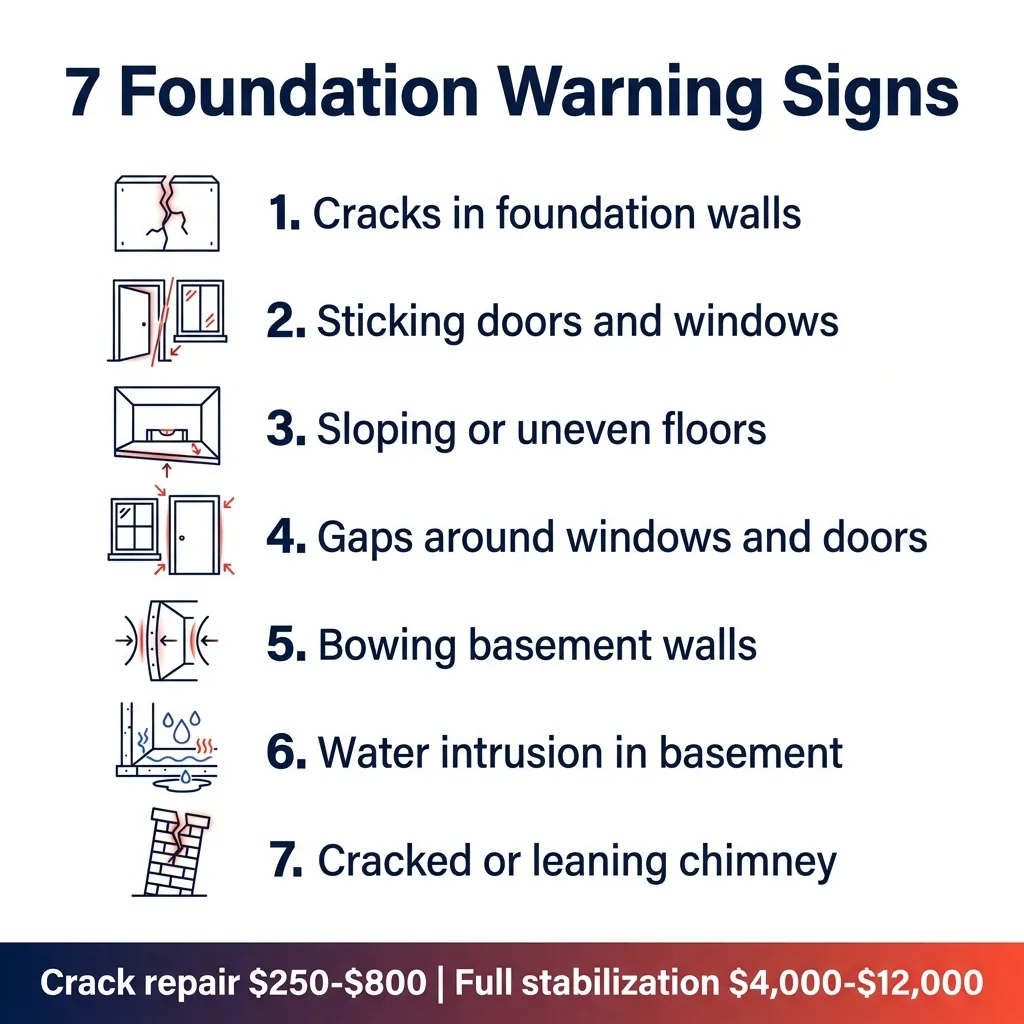
1. Cracks in Foundation Walls
Concrete naturally develops hairline cracks as it cures and ages. Not every crack means disaster.
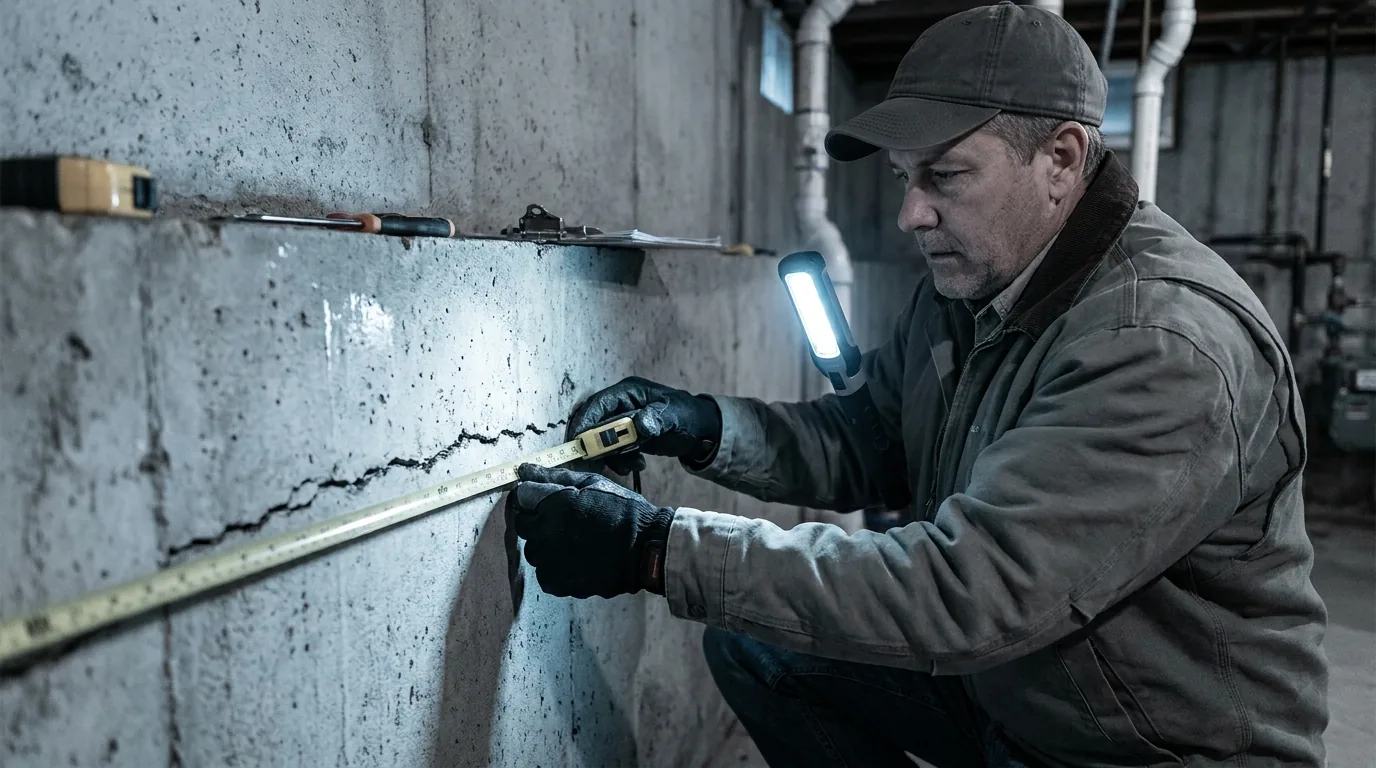
The key is pattern and direction. Vertical hairline cracks, especially in new poured-concrete walls, are often from normal concrete shrinkage. Horizontal cracks are a different story. A horizontal crack running across a block or poured wall signals lateral soil pressure pushing against the foundation from outside. That is a structural concern that needs a professional to look at quickly.
Stair-step cracks in block foundations follow the mortar joints diagonally. They typically indicate differential settlement: one section of the foundation is sinking faster than the adjacent section. The wider the gap, the more active the movement.
2. Doors and Windows That Suddenly Stick
A door that stuck through last summer’s humidity is not a foundation problem. A door that suddenly starts sticking in spring, when the ground is saturated, is worth paying attention to.
When a foundation settles or shifts unevenly, it distorts the rectangular frame of the house. Door frames go out of square. Windows that used to glide smoothly start binding. This sign is easy to dismiss as “the house settling,” but sudden changes after years of normal operation are a signal to look closer.
We see this pattern in split-levels and raised ranches across Monmouth County, where floor loading is uneven and foundation settlement tends to show up first in interior door frames on the first floor.
3. Sloping or Uneven Floors
A floor that slopes or has a noticeable bounce in the middle is often a sign of one of two things: deteriorating floor joists (a structural wood issue) or a settling foundation that has shifted the load path.
You can do a quick check: place a level on the floor in several spots. A slope of more than one inch per eight feet is worth investigating. A marble rolled from one side of the room to the other tells you the same thing faster.
In Monmouth County homes with crawl spaces, soil moisture is a compounding factor. Wet soil under a crawl space leads to wood rot in the sill plate and floor joists, which can look like a foundation problem but is actually a moisture management issue. Both deserve attention.
4. Gaps Between Walls and Ceilings or Floors
Gaps where interior walls meet the ceiling or where wall baseboards pull away from the floor are a visual record of movement. The house is racking, which means opposite corners are shifting in opposite directions.
A small gap that has been there for years and is not growing is usually just old construction. A gap that appeared recently or is visibly widening over months is active movement. Take a photo and check it again in 90 days. If it has grown, call for an assessment.
5. Water Intrusion in the Basement
Water in the basement is not always a foundation failure, but it is always a foundation concern.
When water enters through the wall-floor joint at the base of a basement wall, it often means hydrostatic pressure is building outside: the soil around the foundation is saturated and pushing water through even hairline cracks. Left unaddressed, that pressure can widen cracks and eventually cause wall bowing.
NJ’s spring thaw and nor’easter seasons both create high hydrostatic pressure conditions. Shore-area homes also deal with high groundwater tables that fluctuate with tidal patterns. We handle water intrusion calls frequently through our plumbing services in Long Branch and often work alongside foundation specialists when the source is structural.
6. Bowed or Bulging Basement Walls
A basement wall that is visibly bowing inward is under active lateral pressure. This is not a cosmetic problem.
Even a two-inch inward bow in a basement block wall changes the load path of the entire structure above it. At that point, the wall needs reinforcement, typically carbon fiber straps, steel beams, or piering, before it fails further. Foundation stabilization and reinforcement typically run $4,000 to $12,000, depending on wall length and method.
Bowing is most common in older block-foundation homes. Poured concrete walls bow less but can crack under the same conditions. Both warrant a structural engineer’s assessment before deciding on a repair method.
7. Chimneys Pulling Away from the House
A chimney that is visibly separating from the exterior wall is a classic sign of differential settlement. The chimney sits on its own footing. When that footing settles faster than the main foundation, a gap appears at the roofline or along the exterior wall.
This is one of the easier signs to spot from the street. Walk around the perimeter of your home and look at where chimneys and exterior additions meet the main structure. A gap wider than a quarter inch that has appeared over one or two seasons deserves attention.
How Much Does Foundation Repair Cost in NJ?
Foundation repair costs range widely depending on the type and severity of the problem. According to national cost data, the typical range for foundation repair runs $2,176 to $7,833, with a national average near $5,001.
| Repair Type | Typical Cost Range |
|---|---|
| Crack repair (per crack) | $250 to $800 |
| Mudjacking / slabjacking | $500 to $1,300 |
| Piering or underpinning (per pier) | $1,000 to $3,000 |
| Leak repair | $2,000 to $7,000 |
| Stabilization / reinforcement | $4,000 to $12,000 |
In NJ, permit requirements apply to most foundation repair work. Monmouth County towns require a building permit for structural foundation work, including wall reinforcement, piering, and waterproofing system installation. Permit costs vary by town and project value; contact your local construction office for current fee schedules.
Settling vs. Foundation Problems: Knowing the Difference
All houses settle. New construction settles more in the first few years as the soil compresses under the load. Older homes have largely settled out.
The distinction is between uniform settlement (the whole house sinking slightly together) and differential settlement (one section moving more than another). Uniform settlement rarely causes structural problems. Differential settlement is what creates the cracked walls, sticking doors, and sloping floors described above.
A few cracks in drywall, especially near window corners where stress concentrates, are common in NJ homes after any significant weather event. Those are usually cosmetic. What triggers concern is multiple signs appearing together, or any single sign that is progressing over time.
Our home maintenance services include walk-throughs where we look for early warning signs across the whole house. Catching a gutter drainage problem before it saturates the soil around the foundation is one of the most cost-effective things a Monmouth County homeowner can do. Check out our complete spring home maintenance checklist for a full rundown of what to inspect each year.
Noticing something that doesn’t look right? Our crew can help assess what you are seeing and connect you with the right specialist when the work is outside handyman’s scope. We operate 24/7 across Long Branch and all of Monmouth County. Call or text (732) 924-8444 for a free, no-commitment estimate.
Frequently Asked Questions
1. How do you tell the difference between house settling and foundation problems?
Normal settling creates minor hairline cracks near window corners and slight unevenness that has been there for years. Foundation problems show up as new changes: doors that suddenly stick, cracks that are growing, and floors that were level last year but now slope. If the symptoms are new or progressing, that is a foundation concern, not routine settling.
2. What is the average cost to fix a foundation in NJ?
Foundation repair in NJ typically runs $2,176 to $7,833 for most jobs, with a national average around $5,001. Simple crack repairs start at $250 to $800 per crack. More serious work, like wall reinforcement or piering, runs $4,000 to $12,000 or more. Getting an assessment early is the most reliable way to stay on the lower end of that range.
3. Will homeowners’ insurance pay for foundation repair?
Most standard homeowners’ policies do not cover foundation repairs caused by soil movement, settling, or gradual deterioration. Coverage may apply if the damage resulted from a sudden, covered event, such as a burst pipe that flooded the basement and caused frost heave. Check your specific policy and call your insurer before assuming coverage.
4. How many years does a house foundation last?
A properly built poured concrete or block foundation should last 80 to 100 years or more with reasonable maintenance. The limiting factors in Monmouth County tend to be water management and soil conditions. Homes that have had drainage issues, deferred gutterwork, or poor grading for years often see foundation stress earlier than the structural lifespan would suggest.