Energy costs keep going up. The average Long Branch homeowner spends more on heating and cooling every year, and in a region that swings from single-digit January nights to humid 90-degree summers, your home’s thermal performance matters year-round.
The good news is that most of the biggest efficiency wins don’t require major renovations. They require targeted improvements to the areas where your home is currently wasting energy. Many can be completed in a single service call, and the savings start showing up on your next utility bill.
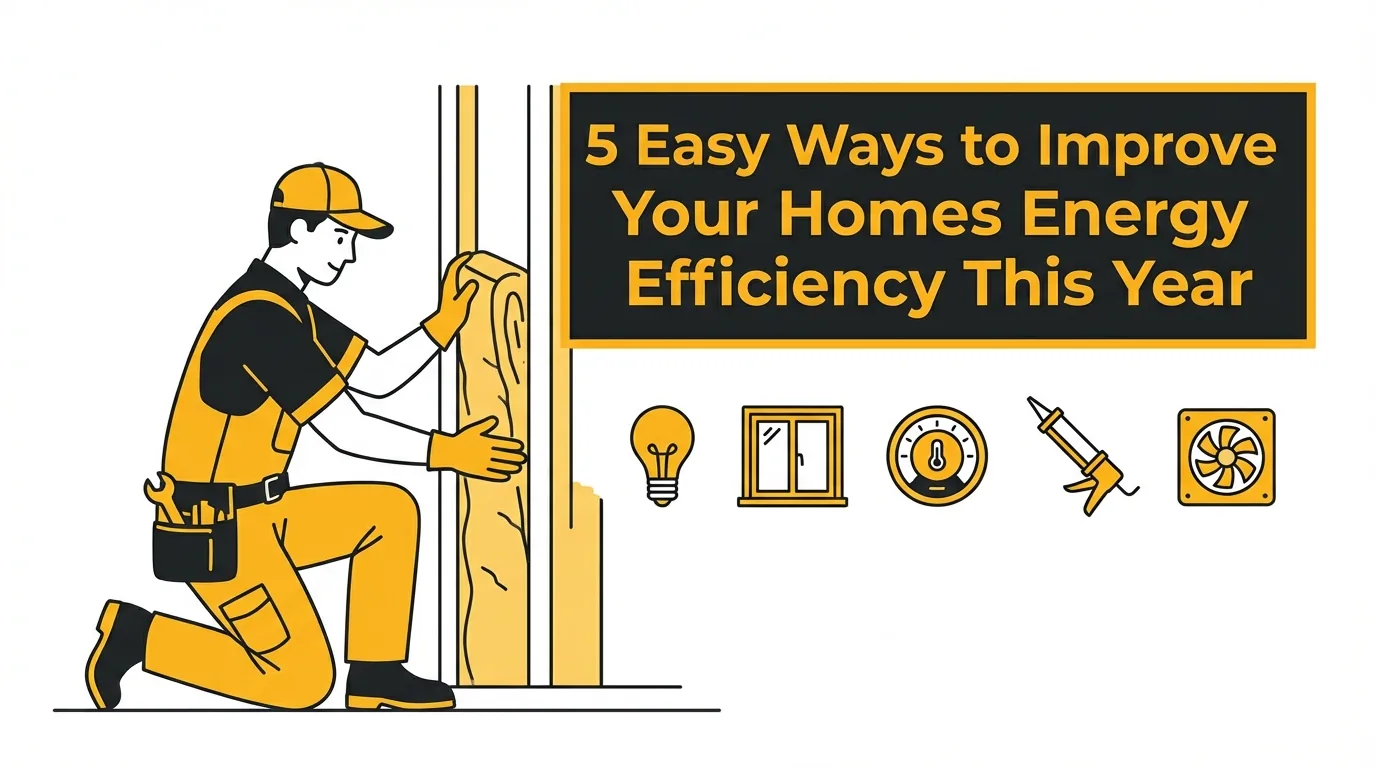
Here are five practical, high-impact ways to improve your home’s energy efficiency in 2026 without a complete overhaul.
1. Install a Smart Thermostat
This is the simplest upgrade on this list and one of the most impactful. Smart thermostats learn your schedule and automatically adjust temperatures when you’re away or asleep, no manual programming required.
According to Energy Star, smart thermostats save homeowners an average of 8% on heating and cooling bills. For the average Monmouth County home spending $2,000+ annually on HVAC, that’s $160 or more back in your pocket every year, from a device that typically costs $150–$250 installed.
Beyond the savings, smart thermostats offer:
A professional installation ensures proper wiring, especially in older homes where basic thermostats may not be compatible with all smart models. Any Time Any Job Handyman handles smart thermostat installation throughout Monmouth County.
2. Seal Air Leaks and Improve Insulation
Air leaks are the silent killers of home energy efficiency. Gaps around windows, doors, electrical outlets on exterior walls, plumbing penetrations, and attic hatches allow conditioned air to escape and outdoor air to infiltrate continuously, 24 hours a day.
According to the U.S. Department of Energy, improving insulation and air sealing in your attic, basement, and exterior walls can reduce heating and cooling costs by up to 15%. For homes with leaky ductwork, sealing those ducts alone can eliminate up to 30% of conditioned air waste before it ever reaches the living space.
Where to focus air sealing efforts: – Around all window and door frames, look for daylight or feel for drafts on cold days – Electrical outlets and switch plates on exterior walls – Where pipes, wires, and vents penetrate exterior walls or the ceiling below the attic – The attic access hatch is one of the most frequently overlooked air leak points in a home – Basement rim joists, the framing at the top of your foundation wall is a major source of heat loss
Weatherstripping is an easy DIY project. But for attic air sealing, insulation top-ups, and rim joist insulation, a professional handyman can complete the work in a few hours with results that last for years.
3. Upgrade to LED Lighting Throughout the Home
If you still have incandescent bulbs anywhere in your home, you’re spending roughly four times more on lighting than necessary.
LED bulbs use about 75% less energy than incandescent bulbs and last up to 25 times longer. Switching every bulb in a typical home to LED costs $150–$300 in materials and delivers immediate monthly savings.
Beyond simple bulb swaps, consider: – Installing dimmer switches on living room and bedroom circuits, dimming LEDs to 50%, reduces energy use by nearly 40% on those circuits – Replacing outdoor floodlights with motion-sensing LED fixtures, these run only when needed, versus incandescent floods that run all night – Upgrading recessed lighting to LED-integrated fixtures, which eliminate the light loss and heat buildup of can lights with bulb retrofits
Dimmer switch installation and light fixture upgrades are quick jobs for a professional handyman. If you have a long list of fixture swaps and switch upgrades, bundling them into a single service call keeps costs down.
4. Address Window Drafts and Improve Window Performance
Replacing all your windows is expensive and rarely delivers the ROI homeowners expect. But addressing the efficiency failures of your existing windows is inexpensive and effective.
Before you spend money on new windows, do this:
Recaulk the window perimeter. The caulk seal between the window frame and exterior siding fails over time, especially through the freeze-thaw cycles common in New Jersey winters. Reapplying exterior caulk around every window takes a few hours and eliminates one of the primary sources of air infiltration in most homes.
Replace interior weather stripping on operable windows that feel drafty when closed. Compressed or torn weather stripping allows air exchange even when windows appear fully closed.
Add window insulation film to single-pane windows during the winter months. This inexpensive film creates a secondary air barrier and can meaningfully reduce heat loss through older glass.
Use insulated window treatments. According to energy efficiency research via Move.org, insulated drapes on south-facing windows can reduce annual energy usage by approximately 18%, roughly $250 per year, at a fraction of the cost of new windows.
If you do have windows with failed seals (foggy glass between panes), cracked frames, or windows that no longer close fully, replacement becomes worthwhile. Any Time Any Job Handyman handles window caulking, weather stripping, and window replacement throughout Monmouth County.
5. Reduce Phantom Load and Optimize Appliance Use
This one requires no tools and no installation — just awareness.
Phantom load (also called standby power) refers to the electricity drawn by devices that are plugged in but not actively in use. TVs, gaming consoles, phone chargers, desktop computers, and kitchen appliances all draw power continuously when plugged in, even in standby mode.
According to research cited by Move.org, eliminating phantom load can save homeowners $100–$150 per year just by unplugging devices or using smart power strips that cut phantom draw automatically.
Additional habits that cut energy costs with no upfront investment:
- Lower your water heater to 120°F, the CPSC-recommended temperature that eliminates scalding risk and reduces standby heating costs
- Run dishwashers and washing machines during off-peak hours (evening or early morning) when utility rates are lower
- Switch to cold-water washing for laundry; the majority of washing machine energy goes to heating water, not the wash cycle itself
- Seal the refrigerator door gasket if it’s no longer airtight. A simple dollar bill test tells you if air is escaping
These habits work together. Combining phantom load reduction, smart thermostat scheduling, LED lighting, and improved air sealing creates a cumulative effect that can reduce your total home energy use by 10–20%, according to efficiency experts.
How Much Can You Actually Save?
| Upgrade | Estimated Annual Savings | Typical Cost |
|---|---|---|
| Smart thermostat | 8% of HVAC costs (~$160+/yr) | $150–$250 installed |
| Air sealing + insulation | Up to 15% of heating/cooling | $300–$1,500 depending on scope |
| Full LED conversion | $200–$500/yr | $150–$300 in materials |
| Window recaulking | Varies; reduces drafts significantly | $100–$300 |
| Phantom load reduction | $100–$150/yr | $0–$50 (smart strips) |
The upgrades above are not theoretical; they’re the practical, well-documented improvements that consistently deliver returns in homes like yours. And most of them can be completed in a single day.

Start With a Professional Walkthrough
Not sure which improvements will have the biggest impact in your specific home? Any Time Any Job Handyman offers home assessment visits throughout Monmouth County. We’ll identify where your home is losing energy, give you a prioritized list of improvements, and handle the work on the same visit or schedule it at your convenience.
We’re available 24/7, 365 days a year, because energy waste doesn’t take weekends off.
Call or text us at (732) 924-8444 for a free quote within 30 minutes.
Serving Long Branch, Red Bank, Middletown, Neptune, Asbury Park, Tinton Falls, and all of Monmouth County, NJ. Fully licensed and insured.