Key Takeaways:
- Winter causes wooden doors to expand up to 0.25 inches, creating alignment issues
- 30% of homeowners experience door problems during cold months
- Over 50% of door misalignment issues can be fixed with simple DIY adjustments
- Proper door maintenance reduces energy loss by up to 15%
- Professional repair costs range from $100-$200 when DIY doesn’t work
- Regular maintenance extends door lifespan by up to 20 years
- Quick fixes include tightening hinges, adjusting strike plates, and planing edges
Introduction
Your front door worked perfectly all summer. Now it scrapes the frame, sticks halfway, or won’t latch at all.
You’re not alone. Approximately 30% of homeowners deal with door misalignment every winter. Cold weather causes wood to expand and contract, metal components to shift, and frames to settle differently than warm months.
Any Time Any Job Handyman in Long Branch, NJ fixes these frustrating problems daily. We’ve seen every type of cold weather door problem in Monmouth County homes—and we know exactly how to solve them.
This guide walks you through the causes and step-by-step fixes you can try yourself, plus when to call a professional.
Why Do Doors Stick and Misalign in Winter?
Winter creates perfect conditions for door problems in Long Branch homes.
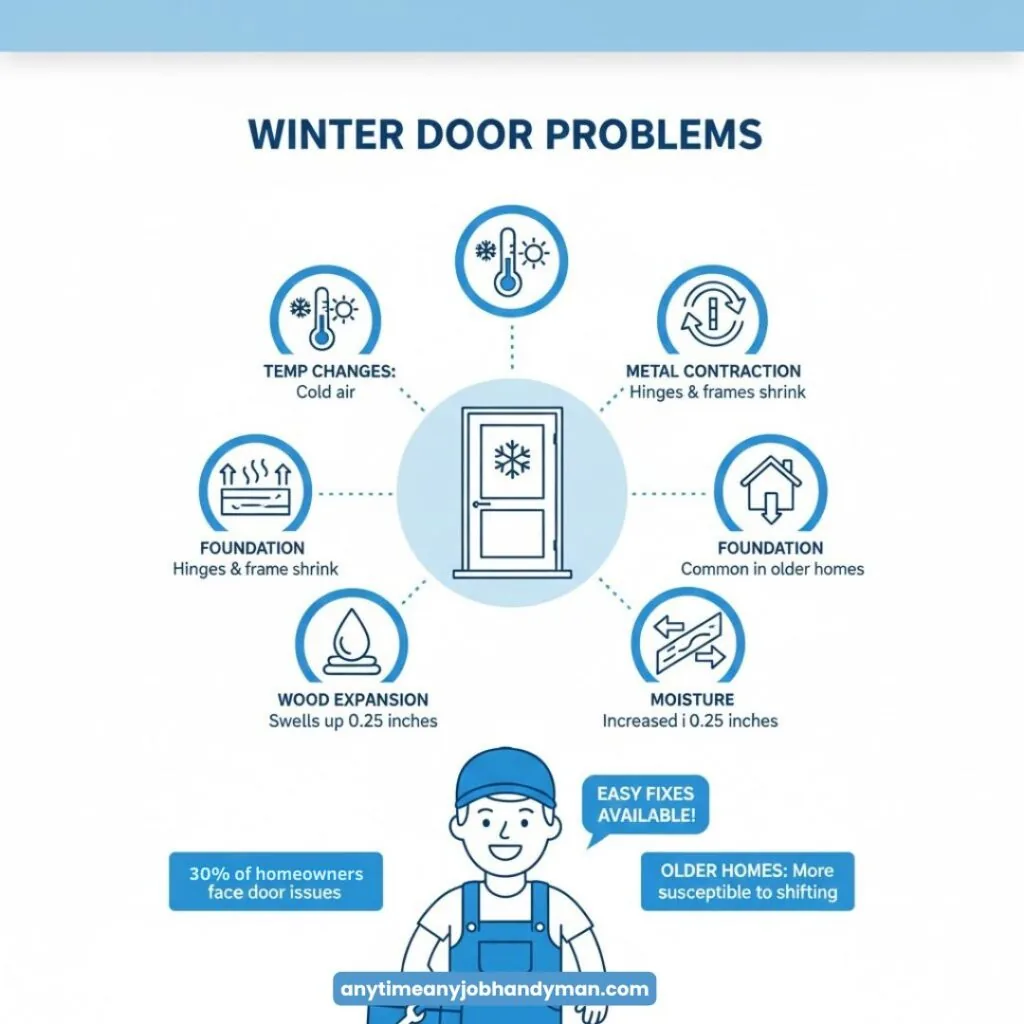
Wood absorbs moisture from humid air, then releases it in dry heated homes. This constant expansion and contraction throws everything off balance. Cold weather can cause wooden doors to expand by up to 0.25 inches, which doesn’t sound like much until your door won’t close.
Metal components contract in freezing temperatures. Your hinges, strike plates, and locksets all shrink slightly. That tiny movement changes how your door sits in the frame.
Foundation settling accelerates in winter. Frozen ground shifts differently than summer soil. Your doorframe moves with it, even if you can’t see the change.
Temperature differences between inside and outside create constant stress. Your heated home at 70 degrees meets 20-degree outdoor air right at your door. That stress zone causes warping over time.
The combination hits Long Branch especially hard. Our coastal humidity, freezing temperatures, and older home construction make door misalignment winter a common problem.
What Are the Quick DIY Fixes for a Sticky Winter Door?
Start with the simplest solutions before getting complicated.
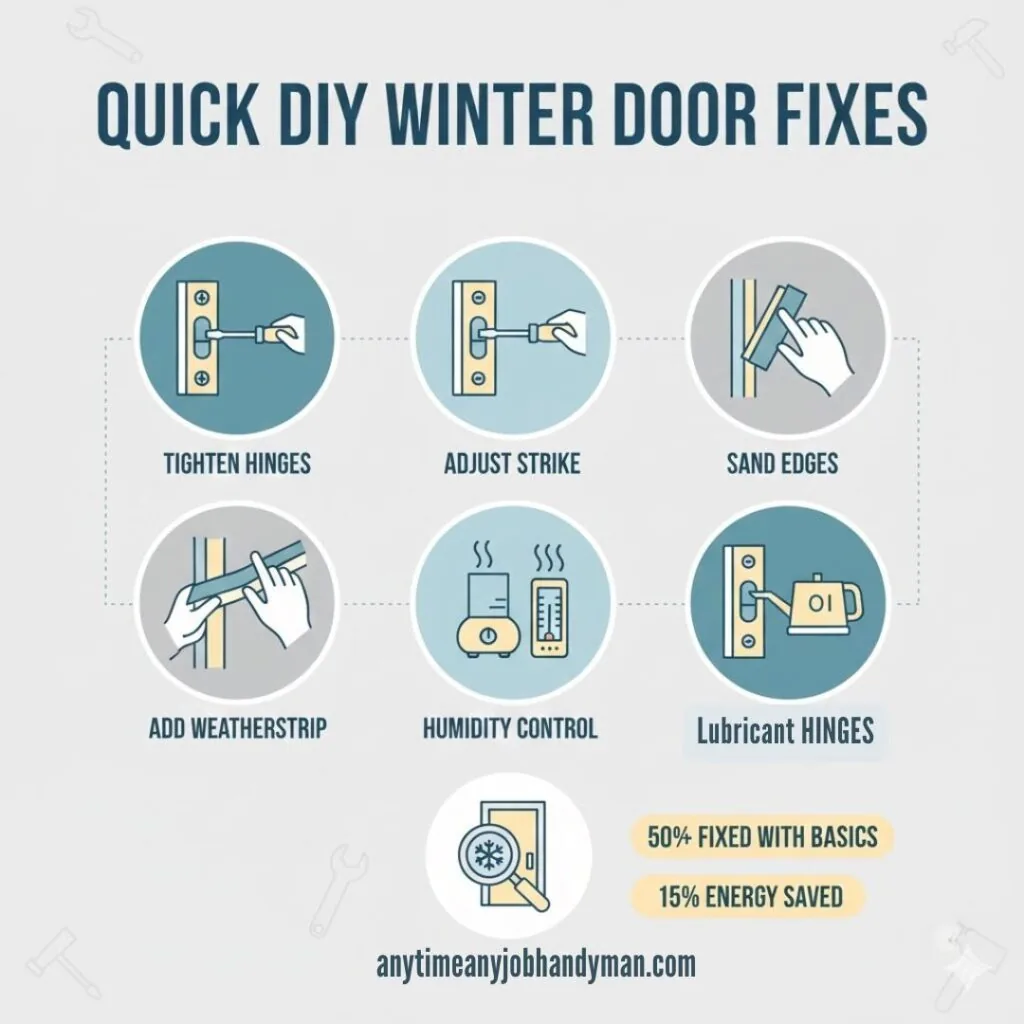
Tighten all hinge screws first. Loose hinges cause most door alignment issues. Use a screwdriver to check every screw on all three hinges. One loose screw throws off the entire door hang.
Check the strike plate position. If your door closes but won’t latch, the strike plate might need adjustment. Loosen the screws slightly and shift the plate up, down, or sideways to meet the latch. Retighten and test.
Look for obvious rubbing spots. Close the door slowly and watch where it catches. You’ll see shiny spots or scrape marks where the door rubs the frame. Mark these with a pencil.
Try the paper test. Close your door on a dollar bill at different spots around the frame. Pull the bill out. It should have slight resistance everywhere. If it slides out easily in some spots and won’t budge in others, you’ve found your alignment problem.
Over 50% of door misalignment issues resolve with these basic adjustments. No special tools needed.
If basic tightening doesn’t work, you’ll need slightly more advanced fixes.
How Do I Fix a Swollen Door That Won’t Close?
Swollen doors need more aggressive treatment than misaligned ones.
Identify the swelling location. Run your hand along the door edges while it’s open. Feel for areas that look puffy or expanded compared to others. The top edge and lock side swell most often.
Remove the door from hinges. Tap out the hinge pins from bottom to top using a hammer and nail. Have someone help you—doors are heavier than they look. Set the door on sawhorses or a stable surface.
Sand or plane the swollen edge. Use 80-grit sandpaper or a hand planer on the problem area. Remove material gradually—you can always take more off, but you can’t put it back. Test fit every few minutes.
Seal the bare wood. Any area you sand or plane needs sealing immediately. Raw wood absorbs moisture faster than finished wood. Use primer and paint or clear polyurethane depending on your door finish.
Rehang and test. Replace hinge pins and check the swing. The door should close smoothly with about 1/8 inch clearance all around.
This fix works for minor swelling. Severe cases mean your door has absorbed too much moisture and might need professional attention or replacement.
Our team at Any Time Any Job Handyman handles swollen door fixes regularly for Long Branch homeowners who need guaranteed results.
When Should I Adjust the Door Frame Instead of the Door?
Sometimes the frame causes the problem, not the door itself.
Check for frame movement. Use a level on all four sides of the doorframe. If the frame isn’t plumb (perfectly vertical) or level (perfectly horizontal), your door can’t possibly close right. Foundation settling or poor installation causes this.
Look for gaps between frame and wall. Shine a flashlight behind the frame trim. Large gaps mean the frame has pulled away from the wall structure. This happens in older Long Branch homes, especially those built before modern building codes.
Test frame flexibility. Push firmly on the frame sides while someone else tries to close the door. If pushing changes how the door fits, your frame mounting is loose.
Check for rot or damage. Exterior doorframes take weather abuse. Probe the wood with a screwdriver, especially at the bottom corners. Soft, spongy wood means rot. Rotted frames can’t hold doors properly.
Frame problems need more expertise than door problems. The frame attaches to your home’s structure. Adjusting it wrong causes bigger issues than a sticky door.
Professional contractors have the tools and experience to reframe doors correctly. We’ve fixed hundreds of frame issues in Monmouth County homes without damaging walls or trim.
What Preventive Steps Stop Winter Door Problems?
Prevention beats repair every time for cold weather door problems.
Seal your door properly. Apply weatherstripping to all four sides of the doorframe. This keeps moisture out and heat in. Replace weatherstripping annually—it compresses and tears with use.
Maintain the door finish. Inspect paint or stain twice a year. Touch up any chips or cracks immediately. Bare wood absorbs moisture 10 times faster than sealed wood. One small chip leads to major swelling.
Adjust your humidity levels. Winter heating dries indoor air. Extremely dry air pulls moisture from wood, causing shrinkage and gaps. Use a humidifier to maintain 30-50% relative humidity. Too much humidity causes swelling, so monitor with a hygrometer.
Lubricate moving parts. Spray hinges, locksets, and latches with silicone lubricant every fall. Moving parts that stick create extra stress on door alignment.
Check alignment seasonally. Test your doors in late fall before hard freezes. Small adjustments then prevent major problems mid-winter.
Implementing proper door maintenance can reduce energy loss by up to 15%. That’s real money saved on heating bills plus avoiding repair costs.
Long Branch’s coastal location means extra moisture exposure. Our home maintenance services include door inspections as part of seasonal checkups.
Regular door maintenance can extend the lifespan of a door by up to 20 years. A $200 door that lasts 40 years instead of 20 is a smart investment.
How Much Does Professional Door Repair Cost in Long Branch?
Professional help makes sense when DIY doesn’t work.
The average cost to repair a misaligned door professionally ranges from $100 to $200. That includes diagnosis, adjustment, and minor repairs like new weatherstripping or strike plate replacement.
More complex repairs cost more. Frame reframing runs $200-$400 depending on damage extent. Full door replacement starts around $300 for basic doors and increases with quality and features.
Compare that to energy costs. A poorly sealed door wastes $100-$300 annually in heating and cooling. Professional repair pays for itself in one winter.
Time matters too. A professional fixes most door alignment issues in 1-2 hours. DIY attempts often take a full weekend, especially if you lack proper tools.
Quality guarantees make professional service worth it. Any Time Any Job Handyman guarantees our workmanship. If the fix doesn’t hold, we come back and make it right. No additional charge.
We also catch related problems during repairs. A handyman door repair visit often reveals weatherstripping damage, threshold issues, or lockset problems you hadn’t noticed. Fixing everything at once saves money versus multiple service calls.
Our licensed handyman near me service covers all door types—entry doors, storm doors, interior doors, sliding doors, and garage doors.
What Makes Door Problems Worse If I Ignore Them?
Small door issues become expensive problems when ignored.
Energy waste compounds daily. A door that won’t seal properly leaks conditioned air 24/7. That gap costs you money every single day. Winter heating bills jump 10-20% with poorly fitting doors.
Security risks increase. Doors that don’t latch properly invite break-ins. Criminals look for easy entry points. A door that doesn’t lock securely is an invitation.
Water damage spreads. Gaps around exterior doors let rain and snow inside. Water runs down walls, under flooring, and into wall cavities. Mold follows moisture. What starts as a sticky door ends as a $5,000 mold remediation project.
Structural stress multiplies. Forcing a misaligned door damages hinges, frames, and even wall structure. Each time you shove that sticky door closed, you’re causing micro-damage that accumulates.
Replacement becomes necessary. Doors that stay misaligned for months warp permanently. Wood takes a “set” in the wrong position. At that point, no amount of adjustment fixes it. You need a new door.
The smart move is addressing door problems immediately. What takes 30 minutes to fix today becomes a major project next month.
Our commercial handyman and residential services cover all door repair needs in the 07740 area and throughout Monmouth County.
We’ve seen doors go from “slightly sticky” to “completely destroyed” in one winter. Don’t let that happen to your home.
How Do Long Branch’s Climate and Older Homes Affect Door Performance?
Long Branch homes face unique door challenges.
Coastal humidity creates constant swelling. Ocean air carries moisture. Your doors absorb it year-round. Winter compounds this because you heat your home, creating extreme humidity differences between inside and outside.
Older construction uses different standards. Many Long Branch homes date back decades. Doorframes installed 40-50 years ago weren’t built to modern tolerance standards. They’re more susceptible to movement and misalignment.
Foundation settling is ongoing. Older homes continue settling long after construction. Each settling event shifts doorframes slightly. Accumulated over years, those tiny shifts become major alignment problems.
Original materials break down. Wood deteriorates. Metal corrodes. Weatherstripping compresses and tears. Materials in older Long Branch homes show more wear than newer construction.
Renovation complications exist. Many local homes have been renovated multiple times. Each renovation potentially changes how doors fit. Adding insulation, replacing siding, or updating trim all affect door operation.
Understanding these local factors helps solve door problems correctly. A fix that works in a 5-year-old home might not work in a 50-year-old Long Branch property.
Our team knows local construction intimately. We’ve worked on homes throughout Long Branch and understand how coastal conditions and older building methods affect repairs.
For related winter challenges, check out our guide on what are the best handyman services for winter in New Jersey.
What Other Winter Home Issues Should Long Branch Residents Watch For?
Winter door problems rarely happen in isolation.
Window drafts indicate similar issues. If your doors stick, check your windows. The same temperature and humidity changes affecting doors impact windows. Addressing both together makes sense.
Heating system strain increases. Drafty doors force your furnace to work harder. Higher energy bills and more frequent repairs follow. Fixing door sealing reduces heating system stress.
Plumbing freeze risks rise. Exterior doors that don’t seal let freezing air into wall cavities where pipes run. Frozen pipes burst. One burst pipe causes thousands in damage. Proper door sealing protects plumbing.
Flooring damage accelerates near doors. Moisture infiltration around poorly sealed doors warps hardwood, lifts laminate edges, and damages subflooring. If you notice laminate flooring separating, check nearby doors.
Ice dam formation worsens. Heat escaping through door gaps rises to your attic and roof. This melts snow that refreezes at roof edges, creating ice dams. Ice dams cause roof leaks. Our handyman roof repair near me service addresses these issues.
Think of your home as a system. Door problems connect to other issues. A comprehensive winter inspection catches everything before minor problems become major expenses.
We offer complete home maintenance services covering all these interconnected systems. One visit can address multiple winter vulnerabilities.
Conclusion
Winter door problems frustrate Long Branch homeowners every year, but they’re solvable. Tighten hinges, adjust strike plates, and address swelling promptly to keep doors functioning smoothly all season.
Know when DIY makes sense and when professional help saves time and money. Small investments in maintenance prevent big repair bills later.
Call or text (732) 924-8444 anytime—we’re available 24/7, 365 days a year with free estimates and guaranteed quality workmanship for Long Branch homeowners.